Category: Presse

  • Opernwelt, february 2019

    Opernwelt, february 2019

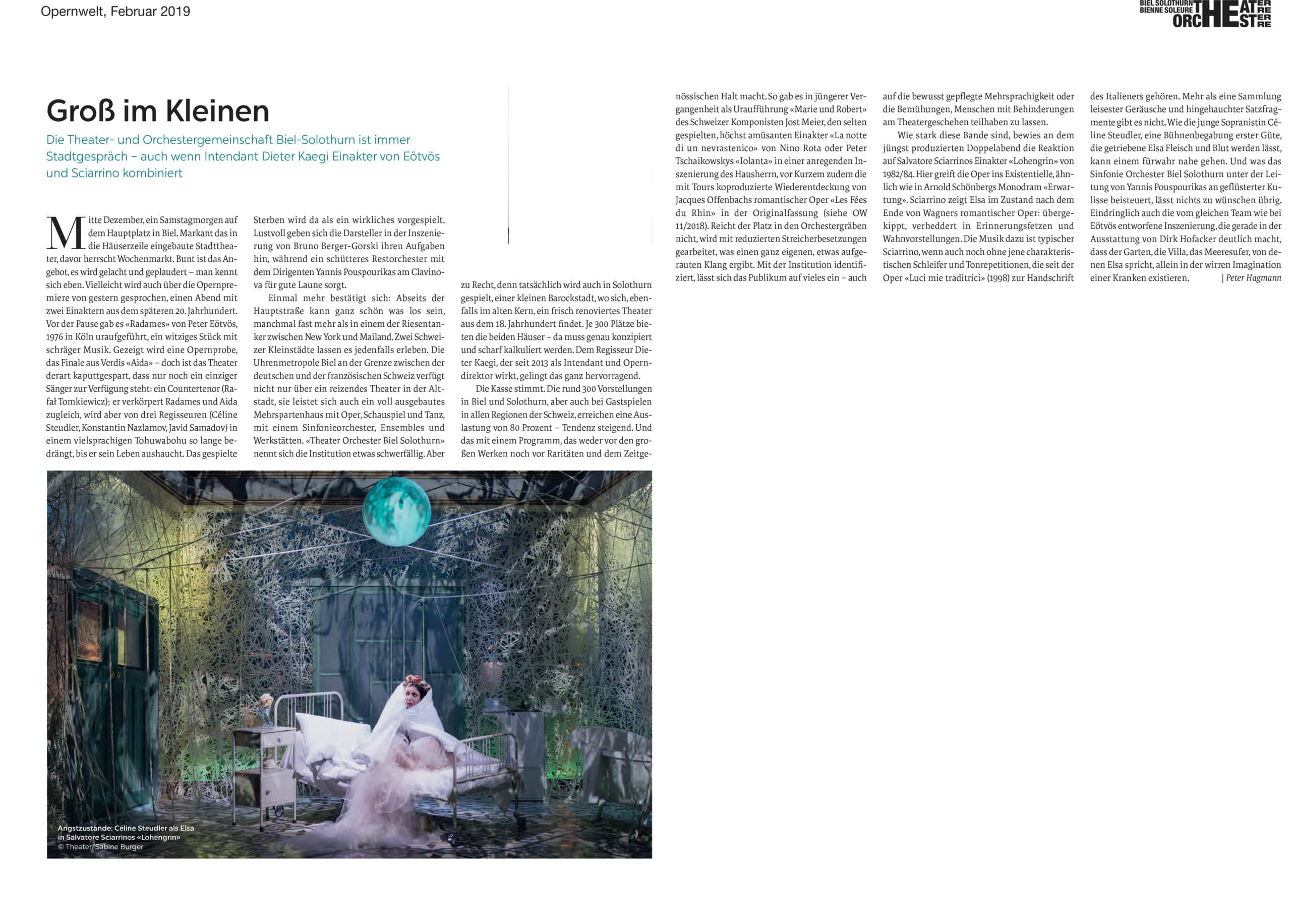
    In this article, Opernwelt highlights the success of the Theatre and Orchestra Biel-Solothurn (TOBS) under the direction of Dieter Kaegi. Despite its modest size and limited resources compared to major European opera houses, the institution manages to offer an ambitious and original program. The author emphasizes the artistic quality of the productions, the commitment of the performers, and the theatre’s ability to balance works from the great repertoire with contemporary creations and rarely performed pieces.

    TOBS also stands out for its strong regional roots, its openness to linguistic diversity, and its determination to attract a broad audience. With around 300 performances per year and a high attendance rate, the institution demonstrates that a medium-sized theatre can play a significant cultural role. The productions mentioned — including works by Peter Eötvös and Salvatore Sciarrino — illustrate this ongoing pursuit of artistic innovation.

    The article thus presents TOBS as a model of dynamism and creativity within the Swiss cultural landscape.

    Source: Peter Hagmann, “Groß im Kleinen”, Opernwelt, February 2019.
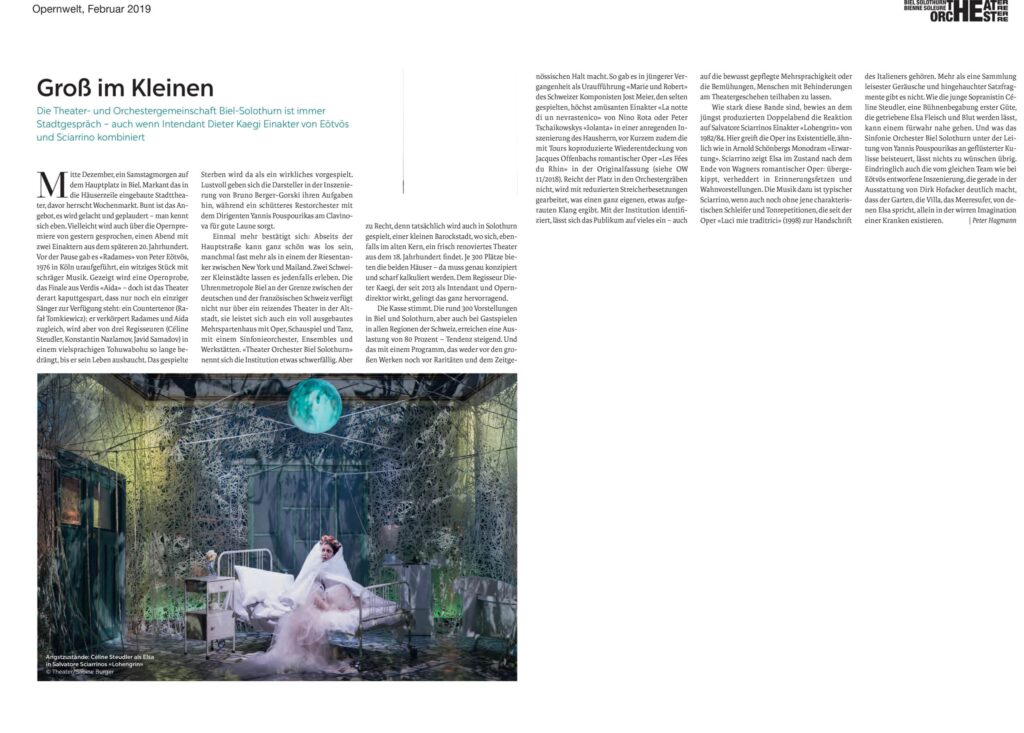
    Mehr als eine Sammlung leisester Geräusche und hingehauchter Satzfragmente gibt es nicht. Wie die junge Sopranistin Céline Steudler, eine Bühnenbegabung erster Güte, die getriebene Elsa Fleisch und Blut werden lässt, kann einem fürwahr nahe gehen.

    Opernwelt, Peter Hamann, février 2019
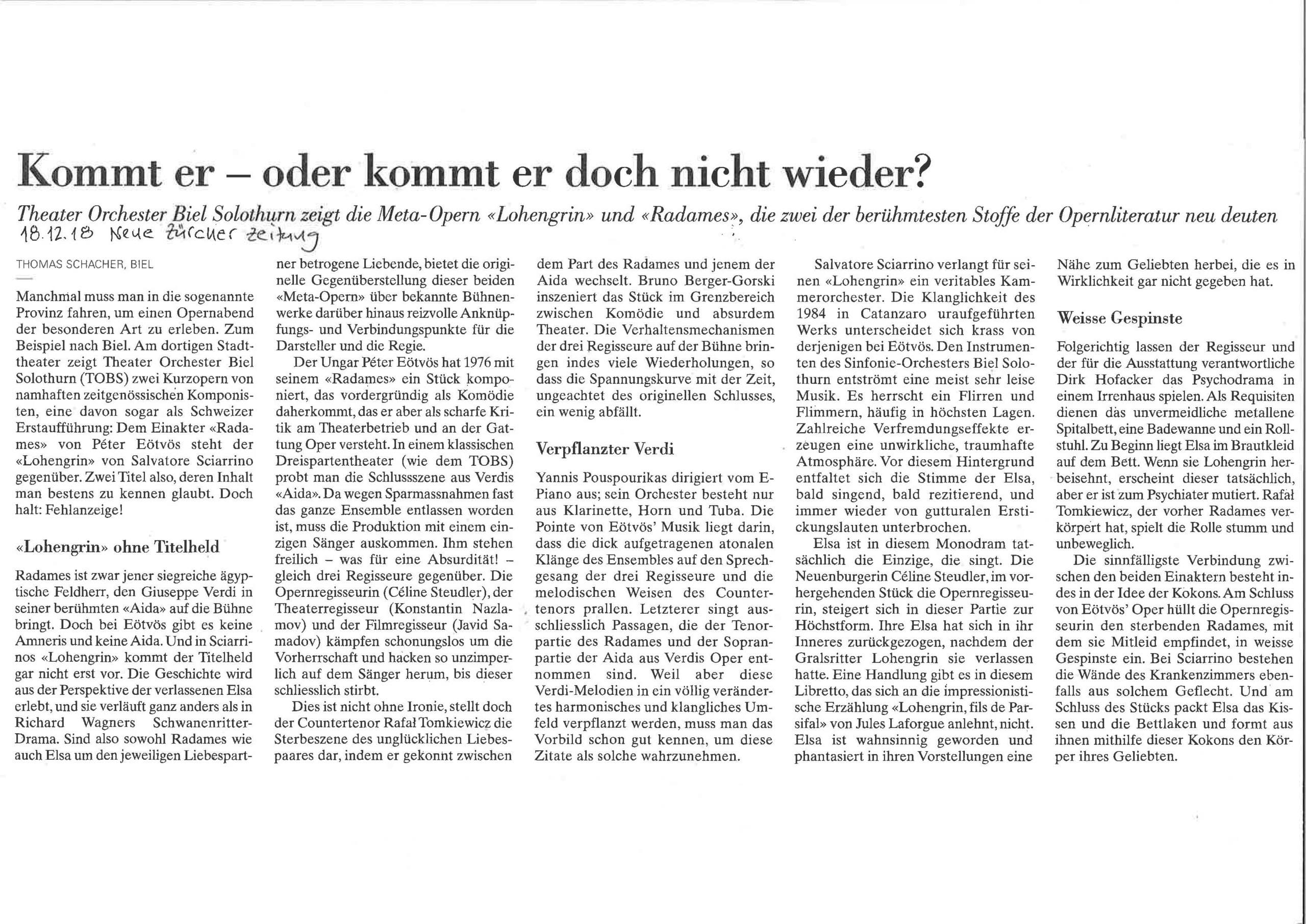
  • NZZ décembre 2018

    NZZ décembre 2018

    The Theater Orchester Biel Solothurn offers a truly original lyrical evening by presenting two contemporary short operas. It presents Radames by Péter Eötvös and Lohengrin by Salvatore Sciarrino, two magnificent pieces that completely reinterpret famous myths with a lot of irony.

    In Radames, a vast comedy sharply criticizing the theater world, a single singer embodies the tragic couple facing three tyrannical directors. This work skillfully mixes complex sounds with the familiar melodies of Verdi. Céline Steudler wonderfully plays the female role here.

    Afterwards, Lohengrin offers an incredibly heavy drama focusing almost exclusively on Elsa, who is brilliantly interpreted by the highly talented soprano Céline Steudler. The invisible knight disappears; Elsa, plunging completely into madness within the psychiatric asylum, relives all her trauma in deep dramatic painful hallucinations.

  • Article dans le Vivre la Ville

    Article dans le Vivre la Ville

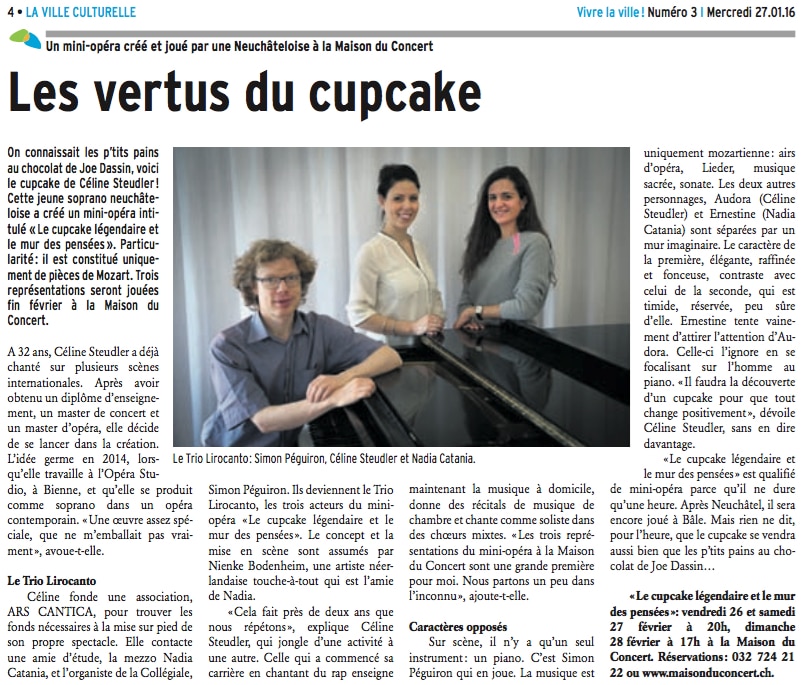
    Un article a été publié dans Vivre la Ville, le journal officiel de la Ville de Neuchâtel

    The talented soprano Céline Steudler presents a new show in Neuchâtel. This unique one hour musical work exclusively uses beautiful classical pieces composed by Mozart.

    On stage, the Trio Lirocanto tells the story of two contrasting women separated by an imaginary wall. Ultimately, finding a tasty cupcake changes everything.

  • Article paru dans l’Express et l’Impartial

    Article paru dans l’Express et l’Impartial

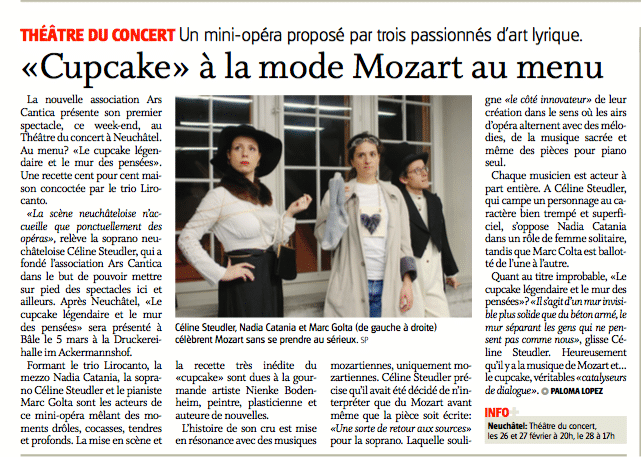
    Promotion du Cupcake Légendaire

    Par Paloma Lopez et Catherine Favre

    The new association Ars Cantica presents a first short opera at the Neuchâtel concert theater. The talented Lirocanto trio performs this play, which will subsequently travel towards the city of Basel.

    This funny and innovative creation perfectly mixes pure comedy with the famous music of Mozart. The three brilliant musicians become true actors to break the invisible solid walls that separate different individuals.


  • Aargauer Zeitung, 3 mars 2014

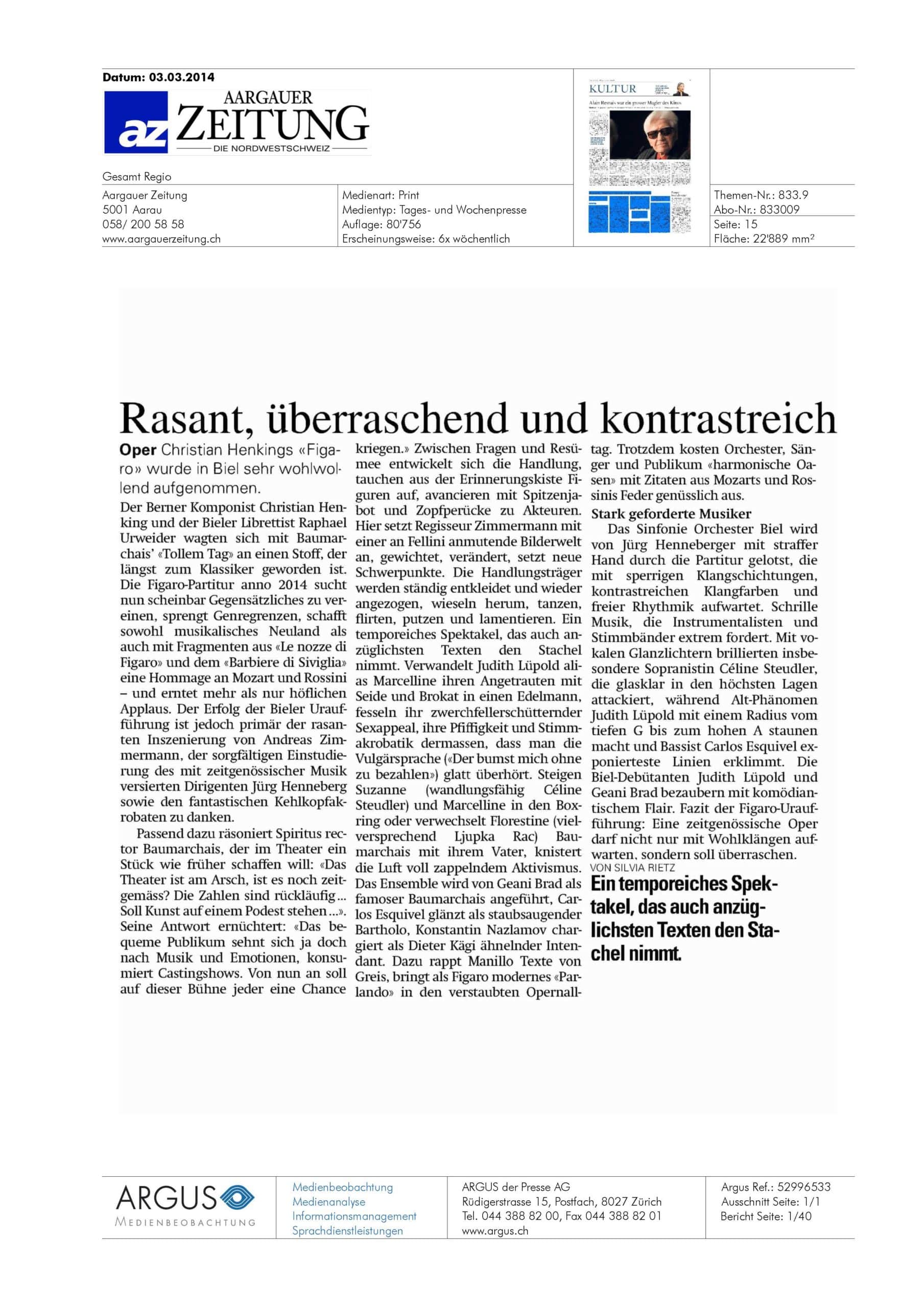
    Aargauer Zeitung, 3 mars 2014

    The contemporary opera “Figaro” by Bernese composer Christian Henking and Biel librettist Raphael Urweider was very well received at its premiere in Biel. Based on Beaumarchais’ classic play, the 2014 score successfully attempts to merge seemingly contradictory elements. It shatters traditional genre boundaries and explores entirely new musical territory, while simultaneously paying homage to Mozart and Rossini by weaving in fragments from their famous operas.

    The performance’s success is largely driven by the fast-paced and highly energetic staging by director Andreas Zimmermann. Featuring Fellini-esque visual imagery, the characters are constantly dressing, undressing, dancing, and flirting. The production deliberately challenges the audience with provocative texts, vulgar language, unexpected boxing ring scenes, and modern rap interludes that brilliantly shake up the dusty, traditional operatic routine.

    The Biel Symphony Orchestra, firmly conducted by Jürg Henneberger, brilliantly navigates the highly demanding and richly contrasting score. The vocal soloists, including the crystal-clear soprano Céline Steudler and alto Judith Lüpold, deliver dazzling acrobatic performances, proving that contemporary opera is truly meant to surprise.

  • Reine Sonja

    Reine Sonja

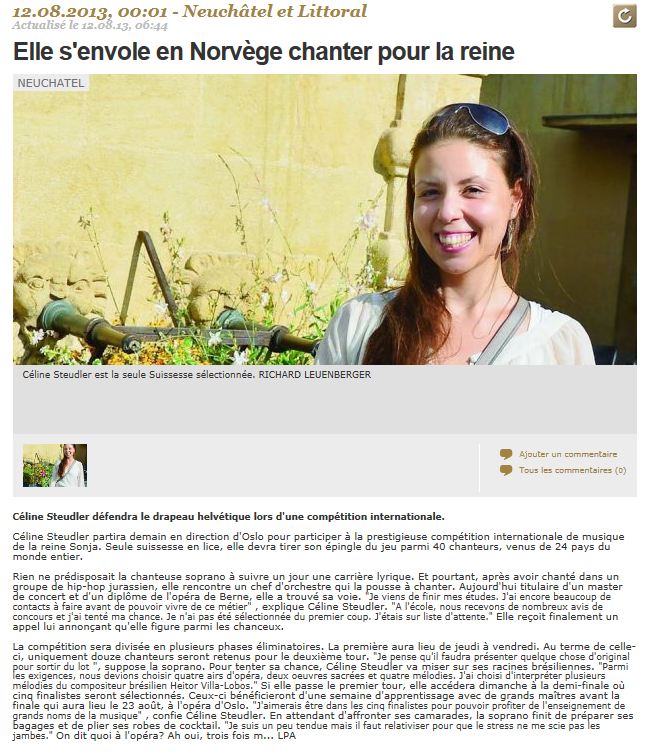
    Soprano Céline Steudler is traveling to Oslo to compete in the prestigious Queen Sonja International Music Competition. As the sole Swiss representative among 40 singers from 24 countries, she aims to stand out in the elimination rounds by performing works by Brazilian composer Heitor Villa-Lobos, honoring her roots. With an unusual background—having formerly sung in a Jurassic hip-hop group—she now holds a diploma from the Bern Opera. Her main goal is to reach the finals on August 23, which would grant her an exclusive week of masterclasses with renowned musical masters.

  • Article paru dans le journal du Jura

    Article paru dans le journal du Jura

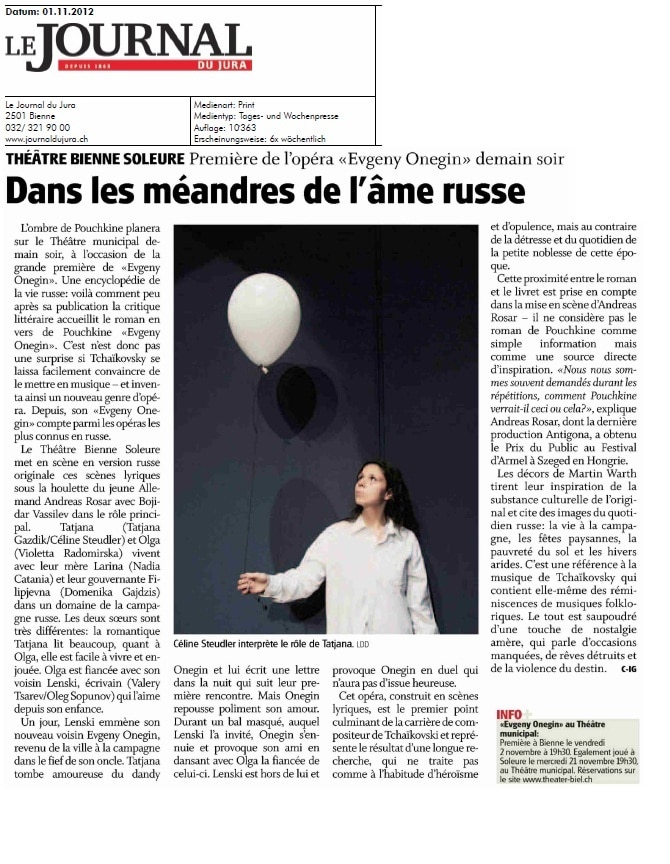
    The Theater Biel Solothurn presents the premiere of Tchaikovsky’s opera “Eugene Onegin,” based on Pushkin’s novel. Directed by the German Andreas Rosar in the original Russian version, the performance authentically explores the Russian soul. The story follows romantic Tatjana, who falls for the dandy Onegin. He rejects her and, out of boredom, seduces the fiancée of his friend Lenski, causing a tragic duel. Moving away from traditional heroism, the direction and Martin Warth’s set design depict the daily life, poverty, and nostalgia of the petty nobility, thus remaining remarkably close to the original literary masterpiece by Pushkin.